
Surroundings
Massif de l'Esterel
Fiery-red rocks plunging into the azure-blue sea, west of Cannes.
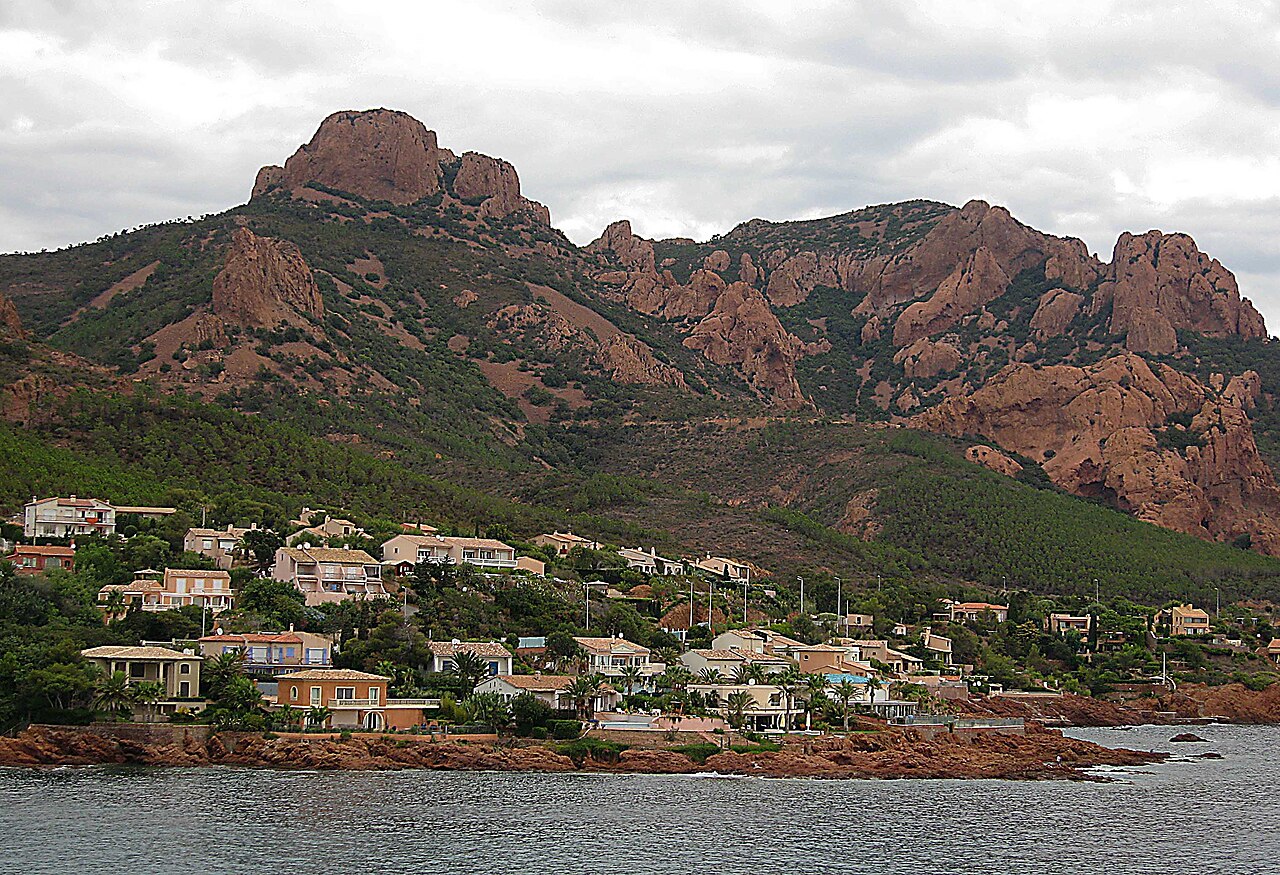
Between Cannes and Saint-Raphaël stretches the Massif de l'Esterel, a rugged, unspoilt range of volcanic origin that is among the most spectacular stretches of coast in all of France. The rocks here have a deep, reddish-brown colour — a volcanic stone called porphyry — and that fiery red, together with the azure blue of the sea and the green of the pine trees, forms an unforgettable palette of colours. For anyone setting out from the apartment in Cannes in search of nature, this wild landscape lies literally just around the western corner.
A landscape of fiery-red rocks
The Esterel was formed millions of years ago by volcanic activity, which gave the massif its characteristic porphyry rocks. The area forms a striking contrast with the softer, limestone mountains elsewhere along the coast: here sharp, red-coloured peaks rise from dense Mediterranean vegetation. The highest summit, the Mont Vinaigre, offers on clear days a sweeping panorama that extends across the whole bay. It is one of the last largely undeveloped stretches of coast on the Riviera, and that very unspoiltness is what makes it so special.
The Corniche d'Or
The finest way to discover the Esterel is along the coastal road, the Corniche d'Or, which winds from bay to bay along the sea. Behind every bend a new panorama awaits, and everywhere lie viewpoints and hidden calanques — small, rock-enclosed coves where you can swim and snorkel in crystal-clear water. Spots such as Pointe de l'Esquillon, Le Trayas, Anthéor and the bay of Agay are among the highlights of the route. The road was built in the early twentieth century and has since been regarded as one of the most beautiful coastal roads in Europe.
Walking and mountain biking
The interior of the massif is a true paradise for walkers and mountain bikers. A network of paths leads between the pine trees, the Mediterranean shrubs and the red peaks. The climb of the Pic du Cap Roux or the Pic de l'Ours is rewarded with a truly sweeping panorama over the whole coast, from the Esterel bays to the mountains of the hinterland. Bring plenty of water, for in summer the massif is hot and there is little shade; some paths are temporarily closed when the fire risk is high.
Swimming in hidden coves
Along the coast of the Esterel lie countless small, intimate coves that you can often reach only on foot or by boat. The water there is remarkably clear, and the red rocks under the water make it a favourite spot for snorkellers. Larger beaches are found around Agay and Le Dramont, where the sand and pebbles stretch between the rocky headlands. The quiet, natural character of these places is a relief after the bustle of the large seaside resorts.
The mimosa in bloom
Those who come in January or February experience a special spectacle: then the mimosa colours the slopes of the Esterel bright yellow. The region is part of the famous Route du Mimosa, and the contrast between the yellow blossom, the red rocks and the blue sea is at those moments at its very finest. It is proof that the Côte d'Azur is worthwhile in winter too.
Practical
The Massif de l'Esterel begins just west of Cannes and is ideal to combine with a journey along the Côte d'Azur towards Saint-Raphaël or Saint-Tropez. By car, by scooter or even by the panoramic coastal train that runs straight through it, this nature area lies literally just around the corner. Take a look at the apartment and the availability and plan your expedition through this breathtaking red wilderness.
Discover more: explore the surroundings of Cannes.
Frequently asked questions
Stay on the Côte d'Azur
Discover the rest of the surroundings, visit our apartment in Cannes or book the available dates for your stay straight away.